If you're weighing a wide receiver or quarterback in a game where rain actually fell, the historical record through 2024 says the biggest fantasy-relevant cost is execution, not scheme: completion rate fell about 1.5 points in rain games, teams possibly backed off early-down passing slightly, and there's no evidence of shorter targets or added turnovers.
The fantasy question behind this study is simple: when rain shows up in a game, does passing production actually sag enough to matter for a lineup call? The registered comparison covers 181 NFL regular-season games with observed rain against 1,056 explicitly rain-free games through the 2024 season, with wind speed, air temperature, week, and season controlled. Two of the four preregistered outcomes moved; two did not.
What actually drops in the rain
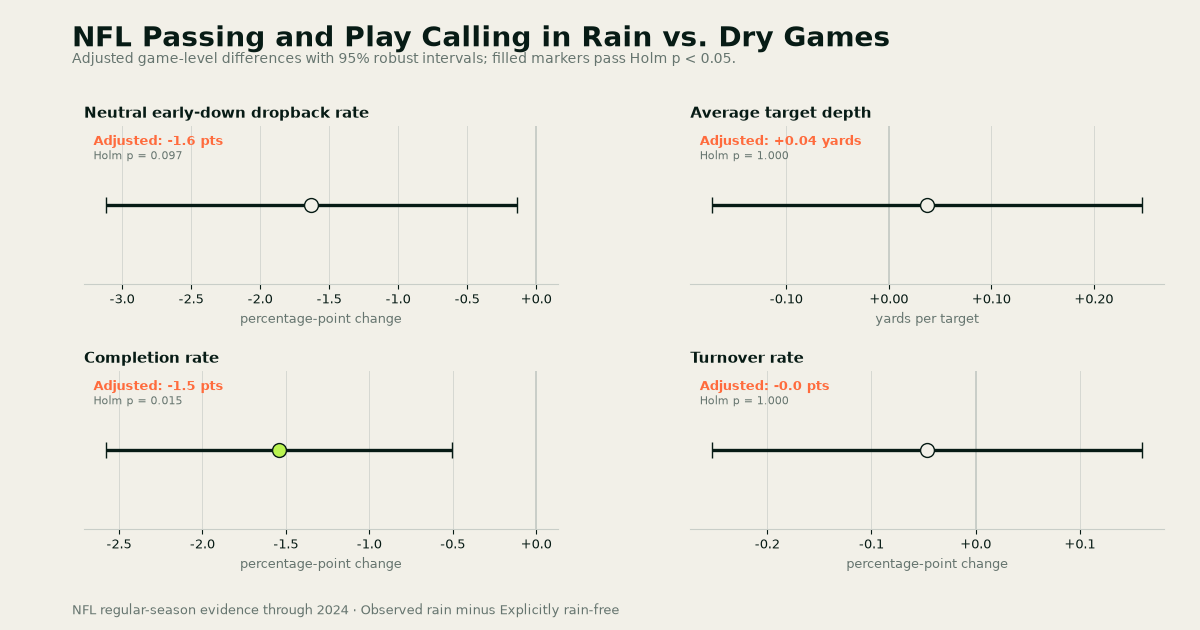
Completion rate is the clearest signal. Rain games averaged 58.2% completions versus 60.0% in rain-free games — an adjusted difference of -1.5 points with a 95% interval from -2.6 to -0.5 points and a Holm-adjusted p-value of 0.015. Because the Holm correction accounts for testing four outcomes at once, this is the one result that stays significant after the stricter bar. In plain terms, that's roughly half an extra incompletion per game at typical team passing volume — a real but modest efficiency hit, not a collapse.
Play calling shows a weaker, less certain shift. Neutral early-down dropback rate — the share of early-down plays with no lead or deficit forcing the issue where the offense drops back to pass — averaged 52.3% in rain games versus 54.0% in rain-free games. The adjusted difference is -1.6 points with a 95% interval from -3.1 to -0.1 points, but the Holm-adjusted p-value is 0.097, which does not clear the conventional significance threshold after correcting for multiple outcomes. Read this as suggestive, not settled: teams may lean slightly away from early-down passing in the rain, but the evidence isn't strong enough to say so with confidence.
What doesn't change
Two common rain narratives don't hold up in this sample. Average target depth was 7.32 yards in rain games and 7.32 in rain-free games — an adjusted difference of +0.04 yards with a 95% interval from -0.17 to +0.25 yards and a Holm-adjusted p-value of 1.000. There's no evidence here that quarterbacks check down more when it's wet. Turnover rate was also flat: 2.0% of plays in rain games versus 2.1% in rain-free games, an adjusted difference of essentially zero with a 95% interval from -0.3 to +0.2 points and a Holm-adjusted p-value of 1.000. The idea that rain games produce a flood of giveaways has no support in this data.
| Outcome | Observed rain | Explicitly rain-free | Adjusted change | 95% interval | Holm p |
|---|---|---|---|---|---|
| Neutral early-down dropback rate | 52.3% | 54.0% | -1.6 pts | -3.1 pts to -0.1 pts | 0.097 |
| Average target depth | 7.32 | 7.32 | +0.04 yards | -0.17 yards to +0.25 yards | 1.000 |
| Completion rate | 58.2% | 60.0% | -1.5 pts | -2.6 pts to -0.5 pts | 0.015 |
| Turnover rate | 2.0% | 2.1% | -0.0 pts | -0.3 pts to +0.2 pts | 1.000 |
Where the evidence stops
These are retrospective associations from observed game conditions, not causal effects — and critically, not a pregame forecast tool. The rain classification here is what actually happened during the game window, which you cannot know before kickoff. A wet historical observation tells you what rain games looked like on average; it does not prove that a pregame weather forecast improves fantasy projections, and it shouldn't be plugged into one as if it were a prediction input. The study also stops at the 2024 season because observed stadium weather data lags one year behind the play-by-play data; the analysis refreshes automatically when the next complete season of weather observations becomes available. And because these are game-level averages, they may not transfer evenly to any individual pass-catcher.
The practical takeaway for fantasy managers: the historical record points to a modest efficiency hit in rain games — fewer completions per attempt — with a possible but unproven slight shift away from early-down passing, and no evidence of shorter targets or added turnovers. That's a small adjustment, not a reason to bench a clear start.
METHODS · SOURCES · REVIEW TRAILOpen the Research File+
QUESTION
In NFL games with observed rain, do teams pass less, throw shorter, complete fewer passes, or turn the ball over more often than in explicitly rain-free games after wind and temperature are controlled?
METHOD
- Registered contrast: observed rain (181 games) vs explicitly rain-free (1,056 games) NFL regular-season games through the 2024 season; 1,237 comparable games total.
- Controls: week and season fixed effects, wind speed (m/s), and air temperature (°C). Adjusted differences use HC3 robust OLS intervals; unadjusted group means are reported alongside.
- Uncertainty: 4,000 game-level bootstrap draws per outcome with SHA-256-derived deterministic seeds; two complete analysis executions produced identical result hashes.
- Multiplicity: Holm-adjusted p-values across the preregistered four-outcome family (neutral early-down dropback rate, average target depth, completion rate, turnover rate).
- Data sources: nflverse NFL schedules and play-by-play (CC BY 4.0), NOAA Global Hourly stadium observations (public domain), and Wikidata stadium coordinates (CC0 1.0) used only for station selection and audit. Primary and secondary weather stations exceeded the registered rain-classification agreement floor.
- Missingness: 2,127 input rows; 890 excluded as outside the registered contrast or incomplete; per-outcome denominators reconciled with zero undefined games among comparable games.
- Source lag: play-by-play data available through 2025, observed weather through 2024; weather-dependent studies stop at the latest available season and retry automatically on refresh.
- Scope: association only. Observed postgame conditions are never eligible as pregame projection inputs, and no causal claim is made.
LIMITS
- Retrospective association; no causal interpretation of rain effects.
- Observed rain classification cannot be used as a pregame forecast feature.
- The neutral early-down dropback result does not survive Holm adjustment (p = 0.097) and should be treated as suggestive.
- Weather data lag limits the sample through the 2024 season.
- Game-level averages may not transfer uniformly to individual players.
SOURCES
- nflverse NFL schedules and play-by-playCC BY 4.0
SHA-256 abd8ad1e4ddbf6cc1df651c0a038f809427de656e69fd488f1c4bd252a8c59ae - NOAA Global Hourly stadium observationsUS Government work; NOAA data are generally public domain
SHA-256 5703be5d0a4e642971a41b2b05674ccd2dd19bdfc09d8cd9761d65a84f88d54f - Wikidata stadium coordinatesCC0 1.0
SHA-256 b53df9a0dc21f55c4cdea95121e1a02170441a2c1aacff2cc4af0f882ff16a53
DOWNLOADABLE DATA
REVIEW TRAIL
Statistics and figures come from deterministic code. The Research File contains the registration, provenance, specialist reviews, and gate decision.