If you've been benching or starting skill players based on whether a retractable roof is open, the scoring data says don't bother: combined points and passing efficiency showed no reliable difference between open- and closed-roof games in the same stadiums. The one place the roof state did show up is the kicker's leg — field-goal accuracy was about 9.6 percentage points higher in open-roof games after adjustment, a difference that survived multiplicity correction.
The fantasy consequence here is mostly about restraint. Open-roof games averaged 49.1 combined points versus 48.8 with the roof closed — a raw gap of less than a third of a point. After controlling for week, season, stadium, and both teams, the adjusted change was +2.5 points with a 95% interval running from -3.5 to +8.4 and a Holm-adjusted p-value of 0.536. That interval is wide enough to include a modest boost or a modest dip, so there's no signal here to act on for team totals, overs, or stacking decisions.
Passing efficiency tells the same null story. Pass EPA per dropback — a per-play measure of how much expected points a pass adds, where zero is neutral — averaged 0.080 in open-roof games and 0.044 in closed-roof games. The adjusted change was +0.041 with a 95% interval from -0.031 to +0.113 and a Holm-adjusted p-value of 0.536. Quarterbacks and receivers were not reliably more or less productive with the roof open.
Kickers are where the comparison gets interesting. Field-goal accuracy averaged 92.4% in open-roof games versus 85.7% with the roof closed. After adjusting for week, season, stadium, both teams, and the average distance of field-goal attempts, the change was +9.6 percentage points with a 95% interval from +3.6 to +15.6 and a Holm-adjusted p-value of 0.007 — the only outcome in the family that cleared the corrected significance bar. Combined kicker fantasy points moved in the same direction: 18.7 in open-roof games versus 17.6 closed, an adjusted change of +3.0 points with a 95% interval from +0.5 to +5.5 and a Holm-adjusted p-value of 0.060. That kicker-points estimate sits just outside conventional significance after correction, so treat it as suggestive rather than settled.
| Outcome | Open retractable roof | Closed retractable roof | Adjusted change | 95% interval | Holm p |
|---|---|---|---|---|---|
| Combined points | 49.1 | 48.8 | +2.5 points | -3.5 points to +8.4 points | 0.536 |
| Pass EPA per dropback | 0.080 | 0.044 | +0.041 | -0.031 to +0.113 | 0.536 |
| Field-goal accuracy | 92.4% | 85.7% | +9.6 pts | +3.6 pts to +15.6 pts | 0.007 |
| Combined kicker fantasy points | 18.7 | 17.6 | +3.0 points | +0.5 points to +5.5 points | 0.060 |
Two caveats keep this honest. First, the open-roof sample is small: 41 open-roof games against 292 closed-roof games across 333 comparable games in retractable-roof stadiums that recorded both states, through the 2025 season. Wide intervals on the scoring and passing outcomes are partly a sample-size story. Second, these are retrospective associations from recorded roof states — the roof state is known after the fact, not something you can reliably project before kickoff, and this study does not show that a pregame forecast of roof state would improve your projections. It also does not establish that opening the roof causes anything; teams open roofs in specific conditions, and those conditions are part of the story.
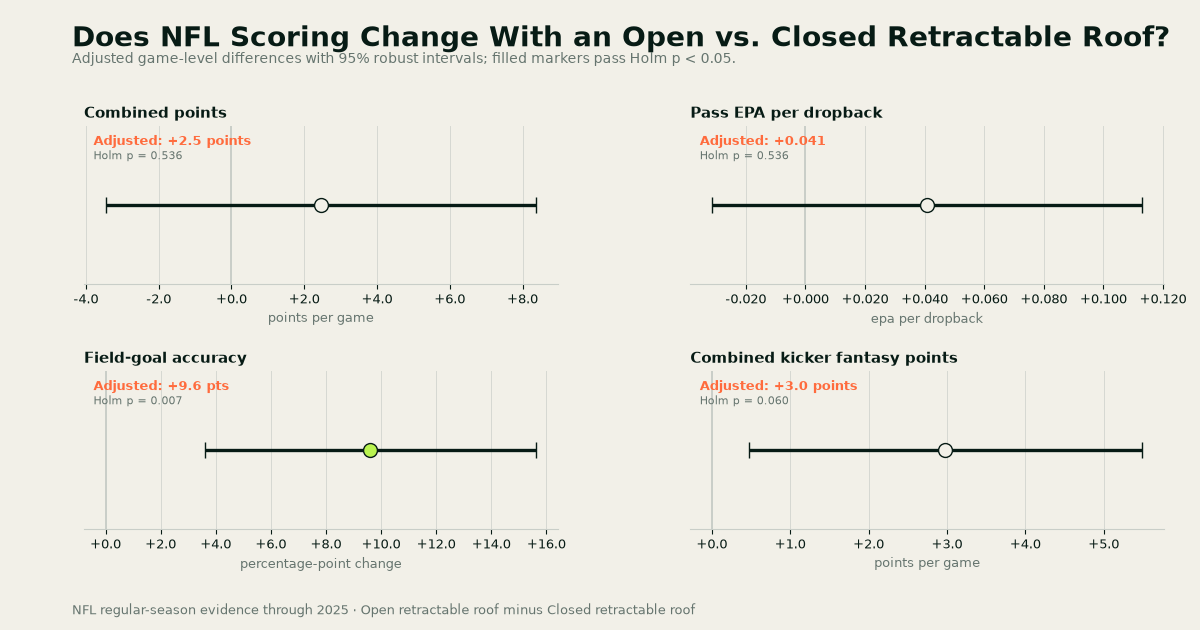
The takeaway for fantasy decisions: don't adjust your expectations for quarterbacks, receivers, or game totals based on a retractable roof being open. The kicker result is real enough to notice — roughly ten percentage points of field-goal accuracy in the same stadiums — but with only 39 open-roof games contributing to that estimate and a Holm-adjusted p-value of 0.007, it's a historical pattern worth tracking, not a license to stream kickers off a roof-state guess.
METHODS · SOURCES · REVIEW TRAILOpen the Research File+
QUESTION
Within retractable-roof stadiums observed in both states, do scoring, passing efficiency, field-goal accuracy, or kicker points change when the roof is open?
METHOD
- Registered comparison: recorded open vs. closed games within retractable-roof stadiums observed in both states, NFL regular-season games from 2018 through the 2025 season.
- Sample: 41 open-roof (condition) games and 292 closed-roof (control) games, 333 comparable games total; field-goal accuracy is defined in 328 games (39 open, 289 closed) because it is undefined when neither team attempts a field goal.
- Controls: week and season fixed effects plus stadium, home-team, and away-team fixed effects; the field-goal accuracy outcome additionally controls for average field-goal distance.
- Uncertainty: 4,000 game-level bootstrap draws and HC3 robust OLS 95% intervals; Holm adjustment across the preregistered four-outcome family.
- Data: nflverse NFL schedules and play-by-play (CC BY 4.0), hashed completed-season release assets for 2018–2025; NOAA weather observations were not an input to any outcome — recorded roof states define the contrast.
- Reproducibility: bootstrap seeds derived per outcome from SHA-256 of the study:outcome label; two complete executions produced identical result hashes (8f950d771f821ecb7114fc4d3871cd7a7cf30f72fceb4746d84e657220127856).
- Limitations: retrospective association only; no causal claim and no claim that observed postgame roof state is a usable pregame forecast feature; small open-roof sample yields wide intervals on the null outcomes.
LIMITS
- These are observed associations, not causal effects — teams choose when to open roofs, and those conditions are entangled with the comparison.
- Recorded roof state is a postgame observation and cannot serve as a pregame projection input.
- The open-roof condition includes only 41 games, so scoring and passing estimates carry wide intervals.
- The kicker fantasy-points result (Holm-adjusted p = 0.060) did not clear the corrected significance threshold and should be read as suggestive.
SOURCES
- nflverse NFL schedules and play-by-playCC BY 4.0
SHA-256 abd8ad1e4ddbf6cc1df651c0a038f809427de656e69fd488f1c4bd252a8c59ae
DOWNLOADABLE DATA
REVIEW TRAIL
Statistics and figures come from deterministic code. The Research File contains the registration, provenance, specialist reviews, and gate decision.